
If you have ever tried to use a standard indoor laser level outside on a bright afternoon, you already know the frustration. That crisp red line you relied on inside the shop vanishes the moment sunlight hits it. Indoor laser levels simply are not built for the demands of outdoor work. The diodes are too weak, the housings lack weather sealing, and the operating range falls far short of what grading, fencing, or foundation work requires.
An outdoor-rated laser level solves every one of those problems. These tools use higher-powered diodes, green beam technology that is far more visible to the human eye, pulse or detector modes that extend range well beyond what you can see, and rugged IP-rated enclosures that shrug off rain, dust, and jobsite abuse. Whether you are a contractor setting elevations across a two-acre lot or a homeowner building a retaining wall in the backyard, the right outdoor laser level saves hours of work and eliminates costly mistakes.
In this guide we break down the best outdoor laser levels available in 2026, explain the critical specs you need to understand before buying, and match each type of laser to the outdoor jobs where it excels.
Quick Comparison
| Our Pick | Type | Range | Accuracy | IP Rating | Battery | Best For |
|---|---|---|---|---|---|---|
We earn a commission if you make a purchase, at no additional cost to you.
|
Rotary | 2,600 ft w/ receiver | 1/16 in at 100 ft | IP66 | Alkaline D-cells, 100+ hrs | Grading, excavation, large sites |
We earn a commission if you make a purchase, at no additional cost to you.
|
Rotary | 1,300 ft w/ receiver | 1/16 in at 100 ft | IP56 | Alkaline D-cells, 50+ hrs | General construction, foundations |
We earn a commission if you make a purchase, at no additional cost to you.
|
Rotary | 1,000 ft w/ receiver | 1/8 in at 100 ft | IP54 | Rechargeable Li-ion | Homeowner grading, DIY drainage |
We earn a commission if you make a purchase, at no additional cost to you.
|
3×360 Line | 250 ft w/ receiver | 1/8 in at 30 ft | IP65 | 12V Max Li-ion | Deck building, outdoor framing |
We earn a commission if you make a purchase, at no additional cost to you.
|
3×360 Line | 200 ft w/ receiver | 1/8 in at 33 ft | IP54 | 12V Max Li-ion | Fencing, landscaping, pergolas |
We earn a commission if you make a purchase, at no additional cost to you.
|
Cross Line | 200 ft w/ receiver | 1/9 in at 33 ft | IP54 | Rechargeable Li-ion | Budget outdoor line work |

Rotary vs Line Laser Levels for Outdoor Use
Before you spend a dollar, you need to decide between the two major categories of outdoor laser levels: rotary and line. Each has a specific set of strengths, and choosing the wrong type for your job leads to wasted money or wasted time.
When a Rotary Laser Level Is the Right Choice
A rotary laser spins a single beam 360 degrees around the unit, creating a continuous level reference plane. Paired with a laser receiver mounted on a grade rod, it can establish elevation across enormous distances, often 1,000 to 2,600 feet or more. That makes it the undisputed choice for site grading, excavation, setting pad elevations, drainage slope work, and any job where you need a consistent reference across a large area. The beam itself is invisible to the naked eye at distance, so you always use a receiver outdoors.
Rotary lasers also tend to have the highest IP ratings and the longest battery life because they are purpose-built for all-day outdoor use on construction sites. If your work involves moving dirt, pouring concrete slabs, or setting elevations across a property, a rotary laser is what you need.
When a Line Laser Level Is the Right Choice
A line laser projects one or more visible lines, often in a 360-degree plane, giving you a bright reference that you can see directly on surfaces. Green line lasers are significantly more visible outdoors than red ones, and many now include pulse modes that work with receivers for extended range. Line lasers excel at shorter-range outdoor tasks: building a fence, framing a deck, setting post heights, laying out a patio, aligning pergola beams, or establishing level lines on an exterior wall.
Their key advantage is that you can see the line directly without a receiver at shorter distances, which speeds up one-person work considerably. The tradeoff is range. Even the best line lasers max out around 200 to 250 feet with a receiver, and visible range without a receiver tops out at roughly 50 to 100 feet outdoors depending on conditions.
Best Rotary Laser Levels for Outdoor Work
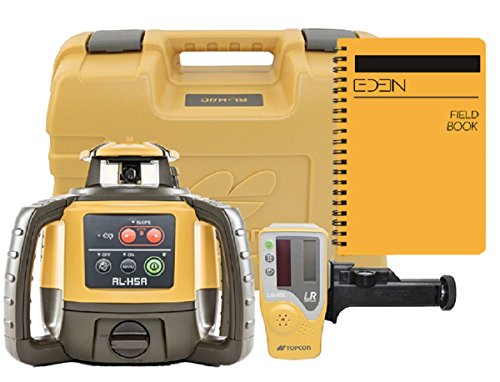
Topcon RL-H5A Self-Leveling Horizontal Rotary Laser
The Topcon RL-H5A is the rotary laser that professionals reach for when accuracy and durability are non-negotiable. With a working range of 2,600 feet using the included LS-80L receiver, it covers even the largest commercial sites without breaking a sweat. Accuracy sits at plus or minus 1/16 inch at 100 feet, which is exactly what you want for finish grading and concrete work.
What sets the RL-H5A apart is its IP66 rating. That means it is fully protected against dust ingress and can handle powerful water jets. You can leave it on the tripod in a downpour and keep working. Battery life is exceptional as well, running over 100 hours on standard alkaline D-cells, so you rarely think about power on a job. The self-leveling range covers plus or minus 5 degrees, and the unit alerts you immediately if it gets bumped out of level.
The RL-H5A is a horizontal-only laser. If you need vertical layout capability, you will need to look at a dual-grade model or pair it with a line laser. For pure elevation and grading work, though, this is the benchmark tool in the industry.
Bosch GRL400H Self-Leveling Rotary Laser with Receiver
The Bosch GRL400H hits a sweet spot between professional capability and reasonable cost. It delivers a 1,300-foot working range with the included LR1 receiver, accuracy of plus or minus 1/16 inch at 100 feet, and an IP56 rating that handles rain and dust on real jobsites. For most residential construction, small commercial work, and serious DIY projects, that range is more than adequate.
Bosch includes a complete kit with receiver, wall mount, carrying case, and batteries, which makes it ready to work right out of the box. The self-leveling range is plus or minus 5 degrees, and it features a manual mode for setting slopes when you need to establish drainage grades. Battery life runs around 50 hours on D-cells.
Where the GRL400H falls slightly behind the Topcon is in weather resistance (IP56 vs IP66) and maximum range. But for contractors who do not regularly work on massive sites, those differences rarely matter in practice. The Bosch delivers pro-grade accuracy in a package that costs significantly less.
Budget Rotary Laser for Outdoor Use
Not every outdoor grading job demands a four-figure laser. If you are a homeowner tackling a drainage project, leveling a shed pad, or setting fence post heights across a large yard, a budget rotary laser under 400 dollars can handle the work. Look for models that include a receiver, offer at least 1,000 feet of working range, carry an IP54 or better rating, and provide accuracy of 1/8 inch at 100 feet or better.
Several manufacturers now offer capable entry-level rotary lasers in this price range. The accuracy will not match a Topcon, and the build quality is a step below, but for occasional use these tools deliver honest performance. The most important thing is to buy from a brand that backs the tool with a real warranty and offers replacement parts for the receiver.
A budget rotary laser is also a sensible backup tool for professional crews. Having a second unit on the truck means one bump or drop does not shut down the entire job while the primary laser goes in for service.
Best Line Laser Levels for Outdoor Work
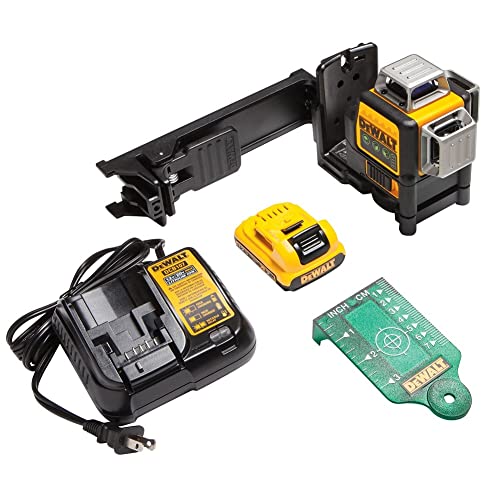
DeWalt DW089LG 12V Max Green 3×360-Degree Line Laser
The DeWalt DW089LG is arguably the most capable line laser you can take outdoors. It projects three independent 360-degree green laser planes: one horizontal and two vertical. That gives you full room layout capability on a deck frame, a pergola build, or any outdoor structure where you need level and plumb references simultaneously.
Green beam technology makes the lines roughly four times more visible to the human eye than red, which is a critical advantage in bright outdoor conditions. With a compatible receiver, the DW089LG reaches out to approximately 250 feet, which covers most residential-scale outdoor projects comfortably. The IP65 rating means it is protected against dust and low-pressure water jets, so working in light rain or dusty conditions is not a concern.
Running on DeWalt’s 12V Max lithium-ion battery platform, you get cordless convenience and compatibility with other DeWalt 12V tools. Battery life varies with the number of planes active, but expect a solid day of intermittent use from a single charge. The magnetic bracket and fine-adjustment mount give you flexible positioning options outdoors where surfaces to clamp onto may be scarce.
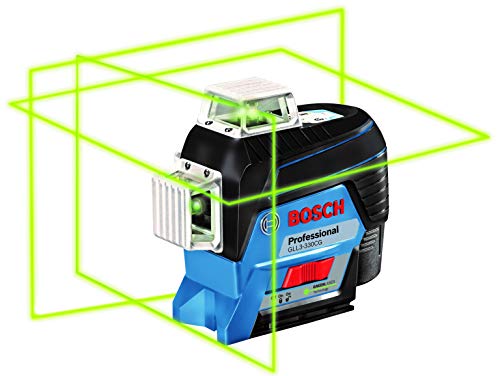
Bosch GLL3-330CG 360-Degree Green Beam Three-Plane Leveling Laser
The Bosch GLL3-330CG competes directly with the DeWalt, offering three 360-degree green laser planes with strong outdoor visibility. Accuracy is plus or minus 1/8 inch at 33 feet, and the working range extends to roughly 200 feet with a compatible Bosch receiver. An IP54 rating provides protection against dust and splashing water.
Where the Bosch distinguishes itself is connectivity. The GLL3-330CG works with the Bosch Leveling Remote app via Bluetooth, allowing you to control the laser, switch planes, and lock lines from your phone. That is a genuine convenience when the laser is set up on a tripod across the yard and you need to toggle between horizontal and vertical planes without walking back.
The unit runs on the Bosch 12V Max battery system. Build quality is excellent, and the included carrying case, target plates, and mount make it a complete outdoor kit. For fencing, landscaping, patio layout, and general outdoor alignment tasks, the GLL3-330CG is a top-tier choice.
Huepar Green Laser Level with Pulse Mode and Receiver
Huepar has earned a reputation for delivering solid performance at aggressive price points, and their outdoor-capable green laser levels continue that trend. Their cross-line models with pulse mode and included receiver offer a working range of up to 200 feet outdoors, an IP54 rating, and accuracy around plus or minus 1/9 inch at 33 feet.
Pulse mode is the key feature here. It modulates the laser beam so a receiver can detect it at distances well beyond naked-eye visibility. Many budget lasers omit this feature, which effectively limits them to indoor use. With pulse mode engaged, a Huepar green line laser becomes a legitimate outdoor tool for fence layout, garden grading at short range, and deck building.
The trade-off compared to DeWalt and Bosch is in build quality and ecosystem support. Huepar uses proprietary batteries rather than a shared tool platform, and the overall fit and finish does not match premium brands. But for homeowners and occasional users who need outdoor line laser capability without spending 400 dollars or more, Huepar represents genuine value.
Key Specs Explained
IP Rating: What IP54, IP65, and IP66 Mean in Practice
The IP rating is a two-digit code that tells you exactly how well a laser level resists dust and water. The first digit rates dust protection on a scale from 0 to 6, and the second digit rates water protection on a scale from 0 to 9.
IP54 means the unit is protected against limited dust ingress (not fully dustproof but enough that dust will not affect operation) and splashing water from any direction. This is adequate for dry-weather outdoor use and occasional light rain. Most line lasers carry this rating.
IP65 means the unit is fully dust-tight and protected against low-pressure water jets from any direction. You can work confidently in rain and on dusty jobsites without worry. This is a strong rating for outdoor line lasers.
IP66 means the unit is fully dust-tight and protected against powerful water jets. This is the gold standard for construction rotary lasers. A tool rated IP66 can sit on a tripod in a thunderstorm and keep working. If you work in consistently harsh outdoor conditions, prioritize IP66.
Working Range: With vs Without Receiver
Every outdoor laser level has two range specs, and confusing them is a common and expensive mistake. The visible range is how far you can see the laser line or dot with the naked eye. Outdoors in bright sunlight, that might be 30 to 100 feet for a green line laser and essentially zero for a rotary laser. The receiver range is how far a compatible laser detector can pick up the beam. This is the spec that matters for outdoor work, and it ranges from 200 feet for line lasers up to 2,600 feet or more for rotary lasers.
Always buy based on receiver range, not visible range, when the tool is primarily for outdoor use.
Accuracy Specs Decoded
Laser level accuracy is expressed as a deviation over distance, typically plus or minus 1/16 inch at 100 feet for rotary lasers or plus or minus 1/8 inch at 30 to 33 feet for line lasers. To understand what this means at your actual working distance, the error scales linearly. A laser accurate to 1/8 inch at 30 feet will be off by approximately 1/2 inch at 120 feet.
For grading and excavation work, 1/16 inch at 100 feet is the professional standard. For fence building, deck framing, and landscaping, 1/8 inch at 30 feet is perfectly acceptable because your material tolerances are much wider than the laser’s accuracy at those distances.
Self-Leveling Range
Self-leveling lasers use an internal pendulum or electronic sensor to automatically find true level within a specified range, usually plus or minus 3 to 5 degrees. If the unit is tilted beyond that range, it will flash or beep to alert you rather than project an inaccurate line. This matters outdoors because you are often setting up on uneven ground. A wider self-leveling range means less fiddling with tripod legs to get the unit roughly level before it takes over.
Battery Life Considerations
Rotary lasers running on alkaline D-cells typically deliver 50 to 100 or more hours of continuous operation. That is days of runtime without a battery change. Line lasers on lithium-ion packs usually run 8 to 14 hours depending on how many planes are active. For all-day outdoor work, carrying a spare battery for a line laser is essential. For rotary lasers, battery life is rarely a concern.
Laser Receivers and Detectors
A laser receiver, also called a laser detector, is the single most important accessory for outdoor laser level work. Without one, you are limited to the visible range of the beam, which plummets in bright sunlight. With a receiver clamped to a grade rod or held against a surface, you can detect the laser beam at hundreds or even thousands of feet away.
Receivers work by sensing the laser light and providing an audio and visual indication of whether you are above, below, or on the beam. Most display a simple arrow and tone system: arrows point you toward the beam, and a steady tone with a centered indicator means you are on grade.
Compatibility Matters
Not all receivers work with all lasers. Rotary laser receivers detect the pulsed beam of a spinning laser and are generally cross-compatible between brands, though you should verify before buying. Line laser receivers require pulse mode on the laser unit itself, and compatibility is more manufacturer-specific. Always confirm that the receiver you are buying works with your exact laser model.
If you are buying a laser and receiver separately, check whether the receiver offers dual accuracy settings. Many professional receivers let you toggle between a fine and coarse detection window. Fine mode gives you tighter accuracy for finish work, while coarse mode speeds up rough grading because it accepts a wider range as on grade.
Which Type for Which Outdoor Job?
| Outdoor Job | Recommended Laser Type | Minimum Range Needed | Minimum IP Rating |
|---|---|---|---|
| Site grading and excavation | Rotary | 1,000+ ft w/ receiver | IP56 |
| Fence installation | Green line (360-degree preferred) | 150 ft w/ receiver | IP54 |
| Deck building | 3×360 green line | 100 ft visible | IP54 |
| Landscape grading and terracing | Rotary (large) or green line (small) | 200+ ft w/ receiver | IP54 |
| Foundation layout | Rotary | 500+ ft w/ receiver | IP56 |
| Drainage slope work | Rotary with grade capability | 500+ ft w/ receiver | IP56 |
| Patio and paver layout | Green line with receiver | 100 ft w/ receiver | IP54 |
| Retaining wall construction | Green line or rotary | 150 ft w/ receiver | IP54 |
A few general rules apply across all these jobs. If the work area exceeds 200 feet in any direction, a rotary laser with a receiver is the only reliable option. If you can keep the laser within 100 feet of where you are working and can see the beam directly on your material, a green line laser is faster and easier for a single operator. And if the job spans multiple days with the laser left on a tripod outdoors, prioritize IP56 or higher regardless of laser type.
Using Laser Levels for Garden Landscaping
I want to share a real-world example that illustrates why an outdoor laser level pays for itself, even on a modest residential project.
Last spring I took on a backyard landscaping project that involved building a three-tier retaining wall along a slope, installing a flagstone patio at the base, and grading a section of the yard for proper drainage away from the house. On paper it was straightforward. In practice, the slope had subtle undulations that a standard bubble level and string line simply could not capture accurately across the full 80-foot run.
I set up a green 3×360 line laser on a tripod at one end of the project and used the horizontal plane as my primary reference. For the retaining wall, I could sight each block course directly against the green line at close range without needing a helper to hold a tape or string. When I got beyond about 60 feet and the line started to wash out in direct sun, I switched to using a receiver on a grade rod and the laser’s pulse mode. That combination let me carry a consistent elevation reference along the entire 80-foot wall line with confidence.
For the drainage grading, I honestly wished I had rented a rotary laser. The line laser worked, but I had to reposition it multiple times to cover the full area, and each reposition introduced a small risk of reference error. A rotary laser on a single tripod would have covered the whole yard from one setup. Lesson learned: for anything involving grading across a large area, a rotary laser is worth the investment or at least a rental.
The patio layout was where the line laser truly shone. I projected both a horizontal and vertical plane simultaneously, giving me a level reference and a perpendicular alignment reference for the first row of flagstone. Setting up those two planes took about 30 seconds. Achieving the same thing with string lines and a framing square would have taken 20 minutes and required stakes I did not want to drive into the prepared base.
The total project took three weekends. I estimate the laser saved me at least five or six hours of measuring, checking, and rechecking that I would have spent with manual methods. More importantly, the retaining wall came out dead level across all three tiers, and the drainage grade consistently falls at the two-percent slope I targeted. Those are the kinds of results that are very difficult to achieve with string lines alone over long distances on uneven terrain.
FAQs
Can I use a red laser level outdoors?
Technically yes, but visibility is extremely limited. Red laser beams wash out in bright sunlight at distances beyond 15 to 20 feet. If you use a red laser outdoors, you will almost certainly need a compatible receiver to detect the beam. Green lasers are roughly four times more visible to the human eye and are the strong preference for any outdoor work where you want to see the line directly.
Do I need a receiver for every outdoor laser job?
For rotary lasers, yes, always. The spinning beam is invisible at any practical distance outdoors. For green line lasers, it depends on the distance and sunlight conditions. In overcast conditions or shade, you can often see a green line out to 50 feet or more without a receiver. In full sun, count on needing the receiver beyond about 20 to 30 feet. Having a receiver available is always recommended for outdoor work regardless of laser type.
What is the difference between IP54 and IP66 for outdoor use?
IP54 protects against limited dust and water splashes. It is fine for dry-weather outdoor use and will survive a brief light rain. IP66 is fully dustproof and can withstand powerful water jets, meaning you can work through heavy rain and on extremely dusty sites without concern. If you work outdoors frequently or in unpredictable weather, the higher rating provides meaningful peace of mind and longevity for the tool.
How accurate does an outdoor laser level need to be?
For professional grading and concrete work, you want plus or minus 1/16 inch at 100 feet, which is the standard for quality rotary lasers. For fencing, deck building, landscaping, and most DIY outdoor projects, plus or minus 1/8 inch at 30 feet is more than sufficient. At typical working distances for these projects, the laser’s accuracy far exceeds the precision you can achieve with the building materials themselves.
Can I use a construction tripod with any laser level?
Most laser levels use a standard 5/8-inch-11 thread mount, which fits standard construction and surveying tripods. Some compact line lasers use a 1/4-inch-20 thread, which is the same as a camera tripod. Check your laser’s mount thread before buying a tripod. Many line lasers include a mounting bracket that accepts the 5/8-inch thread even if the laser body itself uses the smaller mount, giving you compatibility with full-size construction tripods.
