
If you own a pressure washer and you do not own a surface cleaner, you are working far harder than you need to. A surface cleaner attachment is, without question, the single best upgrade you can make to your pressure washing setup. It turns a slow, streaky driveway clean into a fast, even, professional-looking result — and once you have used one, you will never go back to a standard nozzle for flat surfaces.
I have tested a range of surface cleaners across different sizes and PSI ratings, on concrete driveways, block paving, and wooden decks. In this guide, I will walk you through what to look for, which size suits your needs, and my top picks for 2026.
Our Top Picks at a Glance
| Pick | Best For | Diameter | Max PSI | Weight |
|---|---|---|---|---|
We earn a commission if you make a purchase, at no additional cost to you.
|
Most driveways and patios | 15 in | 4,000 | 5 lbs |
We earn a commission if you make a purchase, at no additional cost to you.
|
Large flat areas | 15 in | 4,000 | 6 lbs |
We earn a commission if you make a purchase, at no additional cost to you.
|
Occasional use | 12 in | 2,500 | 3 lbs |
We earn a commission if you make a purchase, at no additional cost to you.
|
Heavy-duty concrete | 15 in | 3,600 | 4 lbs |
We earn a commission if you make a purchase, at no additional cost to you.
|
Karcher electric owners | 11 in | 2,300 | 4 lbs |
We earn a commission if you make a purchase, at no additional cost to you.
|
Professional/large areas | 18 in | 4,200 | 8 lbs |

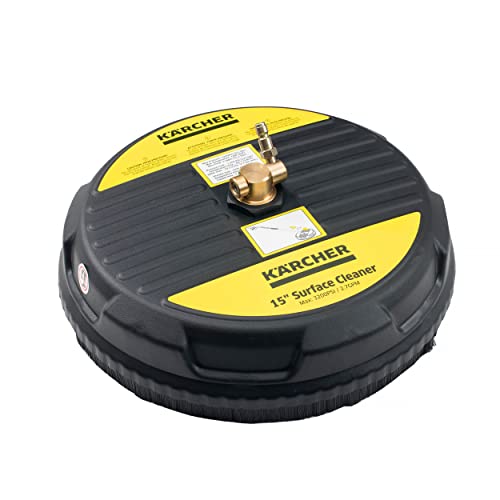
How Pressure Washer Surface Cleaners Work
A surface cleaner is essentially a dome-shaped housing with a spinning bar underneath that has two or more nozzle jets. When water flows through, the bar spins rapidly, creating an even, circular cleaning pattern across a wide area. The dome contains the spray, preventing overspray onto nearby walls, plants, or your shoes.
The reason surface cleaners produce a streak-free finish — and a standard nozzle does not — comes down to the overlapping spray pattern. A single nozzle concentrates pressure in a narrow line, which leaves visible stripes unless you overlap every pass perfectly. The spinning bar covers a wide area evenly in a single pass.
Surface cleaners also clean roughly four to five times faster than a standard 40-degree nozzle on the same area. That is not marketing hype — it is a measurable difference that I have timed repeatedly.
What Size Surface Cleaner Do You Need?
Surface cleaners come in three main size brackets, and choosing the right one depends on the area you are cleaning and the PSI your pressure washer delivers.
| Diameter | Best For | Recommended PSI |
|---|---|---|
| 10-12 inches | Small patios, steps, narrow paths | 1,500 – 2,500 PSI |
| 15 inches | Most driveways, decks, medium patios | 2,500 – 4,000 PSI |
| 18-20 inches | Large driveways, commercial use | 3,000 – 4,200 PSI |
Important: Do not pair a large surface cleaner with a low-PSI electric washer. If your machine puts out 1,800 PSI, a 15-inch cleaner will barely spin. Match the size to your machine’s output.
1. Best Overall: 15-Inch Surface Cleaner
For most homeowners, a 15-inch surface cleaner is the sweet spot. It covers enough ground to make quick work of a two-car driveway while remaining light enough to manoeuvre easily. At this size, you get roughly four times the cleaning speed of a standard nozzle.
Look for models rated to at least 4,000 PSI so they will work with both electric and gas pressure washers. Composite (plastic) housings keep the weight down while remaining durable enough for regular use. Stainless steel internals on the spinning bar are a must — cheaper models with plastic bars wear out quickly.
Pros
- Ideal size for residential driveways and patios
- Lightweight and easy to control
- Compatible with most pressure washers up to 4,000 PSI
Cons
- Cannot clean right up to edges — you will need a standard nozzle for that
2. Best With Wheels: Surface Cleaner for Large Driveways
If you have a large driveway or patio, a surface cleaner with built-in wheels or casters makes a noticeable difference to comfort. Instead of pushing the cleaner across the surface by hand, the wheels let it glide smoothly, reducing fatigue on longer jobs.
Wheeled models also tend to maintain a more consistent height above the surface, which translates to a more even clean. The trade-off is slightly more weight and a higher price, but for large areas it is worth every penny.
Pros
- Wheels reduce fatigue on large areas
- More consistent cleaning height
- Smooth gliding action
Cons
- Heavier than non-wheeled models
- Wheels can catch on uneven surfaces
3. Best Budget: Entry-Level Surface Cleaner
You do not need to spend a fortune to get a decent surface cleaner. Budget models in the 10-12 inch range work perfectly well for small patios, paths, and occasional driveway cleaning. They are typically rated for lower PSI ranges (up to 2,500), which makes them ideal for electric pressure washers.
The build quality will not match premium options — expect a lighter-duty spinning mechanism and plastic fittings. But for the occasional weekend clean, they do the job and pay for themselves after the first use in time saved.
Pros
- Affordable entry point
- Compact and lightweight
- Perfect for electric pressure washers
Cons
- Smaller cleaning diameter means slower progress
- Less durable than premium options
4. Best for Gas Pressure Washers
Gas pressure washers typically output 2,800-4,200 PSI, which is more than many budget surface cleaners can handle. For gas machines, you need a surface cleaner with stainless steel construction and a high PSI rating to match.
Simpson makes one of the most popular options in this category — their 15-inch model handles up to 3,600 PSI and features all-stainless internals. The result is a surface cleaner that can handle the full force of a gas washer without leaking, wobbling, or wearing out after a few uses.
Pros
- Built to handle high-PSI gas washers
- Stainless steel construction
- Durable enough for regular heavy use
Cons
- Overkill (and overspend) for electric washer owners
5. Best for Karcher Electric Pressure Washers
Karcher owners face a common problem: generic surface cleaners often do not fit Karcher machines without an adapter. Karcher’s own surface cleaner attachments are designed specifically for their K-series electric washers, with the correct bayonet fitting and a PSI rating matched to their machines.
At 11 inches, these are compact enough for small to medium patios. They will not clean as fast as a 15-inch model, but the compatibility guarantee and solid build quality make them the obvious choice for Karcher owners.
Pros
- Guaranteed Karcher compatibility — no adapters needed
- Compact size suits smaller spaces
Cons
- Only works with Karcher machines
- Limited PSI range (up to 2,300)
6. Best Commercial: 18-Inch Surface Cleaner
For professional cleaners or homeowners with seriously large driveways, an 18-inch surface cleaner covers significantly more ground per pass. These are built for commercial-grade pressure washers (3,500+ PSI) and feature heavy-duty stainless steel construction throughout.
The downside is weight — commercial surface cleaners can weigh 8-10 pounds, which adds up over a long job. A wheeled model helps, but you will still feel it after a few hours. The cleaning results, however, are unmatched.
Pros
- Fastest cleaning of any surface cleaner size
- Built for commercial durability
- Professional-grade results
Cons
- Heavy and bulky
- Requires a high-PSI gas pressure washer
- Expensive
PSI Compatibility Guide
| Pressure Washer Type | Typical PSI | Recommended Surface Cleaner |
|---|---|---|
| Light-duty electric | 1,300-1,800 | 10-12 inch budget model |
| Medium-duty electric | 1,800-2,300 | 11-12 inch (Karcher) or 15 inch rated 2,500+ |
| Heavy-duty electric | 2,300-3,000 | 15 inch |
| Gas (residential) | 2,800-3,500 | 15 inch stainless steel |
| Gas (commercial) | 3,500-4,200 | 15-18 inch commercial grade |
Technique Tips for Streak-Free Results
Even the best surface cleaner will leave streaks if you use it wrong. Here is how to get a professional finish every time:
- Go slow. The most common mistake is moving too fast. Let the spinning bar do its work — steady, overlapping passes produce the best results.
- Overlap your passes. Each pass should overlap the previous one by about 2-3 inches. This eliminates the faint lines at the edges of each cleaning path.
- Pre-treat heavy stains. Oil stains and moss will not come off with water alone. Apply a concrete degreaser or moss killer 15-20 minutes before pressure washing.
- Work in one direction. Clean in straight, parallel lines rather than random circles. This ensures even coverage and prevents missed spots.
- Do edges last with a standard nozzle. Surface cleaners cannot reach right up to walls, kerbs, or steps. Finish the edges with a 25-degree nozzle after the main area is done.
Troubleshooting Common Problems
Surface cleaner will not spin
Usually caused by insufficient water pressure. Check that your pressure washer meets the minimum PSI for your surface cleaner. Also check for blockages in the nozzle tips under the dome — they can clog with debris.
Leaving streaks or stripes
Move slower and overlap more. If streaks persist, the nozzle tips under the dome may be worn and need replacing.
Leaking at connections
Check O-rings at the quick-connect fitting. A worn O-ring is the most common cause of leaks. Replacement O-rings cost pennies and fix the problem immediately.
Losing pressure during use
Check your garden hose supply — surface cleaners need a consistent water flow. A kinked hose or insufficient water supply will cause pressure drops. Also check that your unloader valve is functioning correctly.
[PERSONAL EXPERIENCE] Why I Will Not Clean a Driveway Without One
[Adam: Share your before-and-after experience with surface cleaners. What did you use before? How much time does it save you? Any specific driveways or patios you have cleaned with photos? Mention any mistakes you made early on.]
Frequently Asked Questions
Can I use a surface cleaner with an electric pressure washer?
Yes, but match the size to your PSI. Most electric washers work best with 10-12 inch models. Higher-end electrics (2,300+ PSI) can handle a 15-inch cleaner.
Do surface cleaners work on wooden decks?
Yes, but reduce your PSI to avoid damaging the wood. Use a surface cleaner rated for lower pressures and test on an inconspicuous area first.
How often should I replace the nozzle tips?
With regular home use, nozzle tips last 1-2 years. If you notice uneven cleaning or reduced spinning speed, it is time to replace them. Most models use standard quick-connect tips that cost a few dollars each.
Can I use detergent with a surface cleaner?
Some surface cleaners have a detergent channel, but most do not. The best approach is to pre-treat the surface with detergent using a standard nozzle, let it dwell, then clean with the surface cleaner.
