
If you’ve spent any time shopping for a table saw that won’t eat your entire garage, you’ve probably landed on the DeWalt DWE7485. It sits in a sweet spot that’s hard to ignore: compact enough for a one-car garage workshop, powerful enough for real woodworking, and priced well under the bigger 10-inch saws. But does the 8-1/4 inch blade limit what you can actually build with it?
I’ve been using the DWE7485 as my primary table saw for over a year now, running everything from plywood sheet goods to hardwood furniture parts through it. This review covers what I’ve actually experienced — the good, the frustrating, and the stuff DeWalt doesn’t mention in the marketing materials.
If you’re a DIYer working in a small shop, a contractor who needs a reliable jobsite saw, or someone building out their first serious tool collection on a budget, this saw deserves a close look. Let’s get into it.
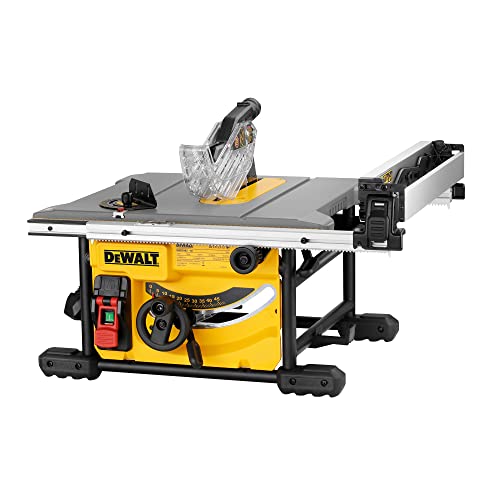
Key Specifications
| Specification | Detail |
|---|---|
We earn a commission if you make a purchase, at no additional cost to you.
|
15 Amp, 120V |
We earn a commission if you make a purchase, at no additional cost to you.
|
8-1/4 inch |
We earn a commission if you make a purchase, at no additional cost to you.
|
5,800 RPM |
| Rip Capacity (Right of Blade) | 24-1/2 inches |
| Rip Capacity (Left of Blade) | 12 inches |
| Max Depth of Cut at 90 degrees | 2-5/8 inches |
| Max Depth of Cut at 45 degrees | 1-13/16 inches |
| Bevel Capacity | 0 to 47 degrees |
| Table Surface | 22-3/8 x 16-1/8 inches |
| Dust Port Size | 2-1/2 inches |
| Weight | 48 lbs |
| Warranty | 3-Year Limited |

The numbers that matter most here are the 24-1/2 inch rip capacity and the 2-5/8 inch max cut depth. That rip capacity means you can rip a sheet of plywood right down the center. The cut depth handles anything up to nominal 3-inch lumber, which covers the vast majority of DIY and furniture projects.
Build Quality and First Impressions
Out of the box, the DWE7485 feels like a serious tool. At 48 pounds, it’s heavy enough to stay planted during cuts but light enough that one person can move it around a shop or load it into a truck bed without help. The weight distribution is surprisingly good — it doesn’t feel top-heavy or tippy when you’re pushing stock through it.
The table surface is cast aluminum, not stamped steel. That matters. I checked mine with a 24-inch straightedge when it arrived and measured less than 0.005 inches of deviation across the full surface. For a portable saw in this price range, that’s excellent. Some users report needing to shim or adjust their miter slots, but mine was dead-on out of the box.
The overall fit and finish is what you’d expect from DeWalt’s upper-tier portable tools. The adjustment knobs feel solid, the bevel lock engages positively, and the blade guard assembly is well-made even if you’ll probably remove it for most precision work. The on/off switch is a large paddle design that’s easy to hit with your knee in an emergency — a small detail that matters more than you think.
One thing I noticed immediately: the saw is quieter than my old contractor saw. Not whisper-quiet, but noticeably less aggressive at idle. Under load, it’s comparable to other 15-amp saws I’ve used.
Performance Testing
Specs are one thing. What the saw actually does on the job is what counts.
Ripping Hardwood
I ran 4/4 red oak, hard maple, and walnut through the DWE7485 at various widths. With the stock 24-tooth blade, the saw handled all three species without bogging down, though you can feel the motor working harder in maple. Feed rate matters here — push too fast in dense hardwood and you’ll hear the RPM drop. At a reasonable feed rate (roughly 3 to 4 inches per second in oak), the cut quality is clean with minimal tear-out.
Switching to a quality 40-tooth combination blade made a noticeable difference in cut quality. The stock blade is fine for construction lumber and rough dimensioning, but a Freud Diablo or similar aftermarket blade transforms this saw for furniture-grade work.
Crosscutting
Crosscuts in dimensional lumber up to 2×6 are handled easily. The miter gauge (more on that later) limits precision somewhat, but for rough crosscutting to length, it gets the job done. For anything requiring accuracy, I use a crosscut sled, which the miter slots accept without issue.
Sheet Goods
This is where the 24-1/2 inch rip capacity earns its keep. Ripping half-inch and 3/4-inch plywood is smooth and predictable. I’ve cut down full 4×8 sheets of birch plywood for cabinet builds with consistent results. The fence holds its position throughout the cut, and the outfeed support (if you set one up) makes full-sheet work manageable solo.
Motor Under Load
The 15-amp motor handles most tasks confidently. It will slow down in thick, dense hardwoods if you push aggressively, and I’ve tripped the thermal overload once while ripping 8/4 maple on a hot day. For typical DIY and light professional use — 3/4 inch plywood, dimensional lumber, 4/4 hardwoods — the motor has plenty of power. Just don’t expect it to perform like a 3 HP cabinet saw.
The Rack and Pinion Fence System
The fence is the standout feature of this saw, and it’s not close. DeWalt uses a rack and pinion system instead of the traditional clamp-style fence you’ll find on most portable saws. What does that mean in practice?
You turn a knob, and the fence glides smoothly along a toothed rail. No slamming it into position and hoping it lands where you want. No wrestling with a sticky lock mechanism. You dial it in, lock it down, and it stays put.
I tested fence accuracy by setting it to 6 inches and making 10 consecutive rip cuts in 3/4-inch plywood without readjusting. I measured all 10 pieces with digital calipers. The results ranged from 5.995 to 6.007 inches — a total spread of 0.012 inches across 10 cuts. That’s well within acceptable tolerance for cabinetry and furniture work.
The fence also stays parallel to the blade throughout its travel. On cheaper saws, the fence can toe in or out as you move it further from the blade. The rack and pinion system on the DWE7485 eliminates that problem almost entirely. I measured less than 0.003 inches of deviation from parallel across the full 24-1/2 inch rip range.
If you’ve ever fought with a lousy fence on a cheap table saw, this alone might be worth the upgrade.
Dust Collection — Does It Actually Work?
Let’s be honest: dust collection on portable table saws is usually an afterthought, and manufacturers’ claims are optimistic at best. The DWE7485 has a 2-1/2 inch dust port on the back of the cabinet that connects to a standard shop vacuum hose.
With my Ridgid shop vac connected, the saw captures what I estimate is about 60 to 70 percent of the dust generated during rip cuts. That’s better than most portable saws I’ve used, but it still means a fair amount of fine dust escapes from the blade opening on top and from the sides of the cabinet. Crosscuts generate more above-table dust, and the collection rate drops noticeably.
The blade guard includes a dust collection attachment point, which helps capture above-table dust when it’s installed. With both the lower port and the blade guard connected, dust collection improves to what I’d estimate is around 80 percent — genuinely usable. The problem, of course, is that most woodworkers remove the blade guard for precision work, which takes the above-table collection out of the equation.
Bottom line: it’s adequate for a portable saw. You’ll still want to wear a dust mask, and you’ll still be sweeping up after a session. But it’s a real improvement over saws that just dump everything onto the floor.
What I Like
- The fence system is genuinely excellent. Rack and pinion at this price point is a real differentiator. Accurate, repeatable, and easy to adjust.
- Compact footprint. Fits easily against a wall in a small shop. Doesn’t dominate the room like a full-size contractor saw.
- Portability without compromise. Light enough to move, heavy enough to feel stable. Good balance of both.
- 24-1/2 inch rip capacity. Enough to rip plywood down the center. Many compact saws max out at 18 or 20 inches.
- Build quality. The cast aluminum table, solid miter slots, and overall construction feel like they’ll last.
- Quiet operation. Noticeably less harsh than many portable saws at idle and under light load.
- Good safety features. Anti-kickback pawls, riving knife, blade guard, and that large paddle switch.
What Could Be Better
- The miter gauge is mediocre. It works, but there’s noticeable slop in the miter slot. For precise crosscuts and miters, plan on building a sled or buying an aftermarket gauge. This is common on portable saws, but still disappointing at this price.
- No dado stack capability. The arbor won’t accommodate a dado set. If you need dado cuts, you’ll need to make multiple passes or use a router. For some woodworkers, this is a dealbreaker.
- 8-1/4 inch blade limits depth of cut. You max out at 2-5/8 inches at 90 degrees. That handles most tasks, but if you regularly work with 4×4 or thicker stock, you’ll need a 10-inch saw.
- Blade availability. 8-1/4 inch blades have fewer options than the standard 10-inch size. You’ll find good choices from Freud, Diablo, and DeWalt, but the selection is notably smaller. Expect to pay about the same as a 10-inch blade for fewer options.
- No rolling stand included. The saw sits on rubber feet out of the box. DeWalt sells a compatible stand separately, or you can build your own workstation. The DWE7491RS includes a stand — this one doesn’t.
- Dust collection is good, not great. The 2-1/2 inch port works, but fine dust still escapes above the table, especially during crosscuts.
DWE7485 vs DWE7491RS — Which DeWalt Table Saw?
This is the most common comparison, and for good reason. Both are DeWalt. Both are portable. But they serve different needs.
| Feature | DWE7485 | DWE7491RS |
|---|---|---|
| Blade Size | 8-1/4 inch | 10 inch |
| Rip Capacity | 24-1/2 inches | 32-1/2 inches |
| Max Cut Depth (90 deg) | 2-5/8 inches | 3-1/8 inches |
| Dado Capable | No | Yes |
| Weight (saw only) | 48 lbs | 58 lbs |
| Rolling Stand | Not included | Included |
| Price Range | – | – |
Choose the DWE7485 if: You have a small shop, want maximum portability, work primarily with plywood and 4/4 hardwoods, and don’t need dado cuts. The savings over the 7491RS can go toward a quality blade and other accessories.
Choose the DWE7491RS if: You need dado capability, work with thicker stock regularly, want the wider 32-1/2 inch rip capacity for larger sheet goods, or want the rolling stand included. It’s a bigger, heavier saw, but it’s also more versatile.
For most DIYers working in a garage or basement shop, the DWE7485 does everything they need at a lower price and smaller footprint. If you’re doing more serious cabinetry or furniture work and have the space, the DWE7491RS is worth the step up.
DWE7485 vs Bosch GTS1031
If portability is your top priority, the Bosch GTS1031 deserves consideration. It’s the most portable full-featured table saw on the market, with a clever carry-handle design and a weight of about 52 pounds.
The GTS1031 runs a 10-inch blade, giving it a deeper cut capacity (3-1/8 inches at 90 degrees) and more blade options. It also supports dado stacks up to 1/2 inch wide. However, its rip capacity tops out at 18 inches to the right of the blade — significantly less than the DWE7485’s 24-1/2 inches. That means you can’t rip a sheet of plywood down the center without repositioning.
The fence system on the Bosch is functional but not in the same league as DeWalt’s rack and pinion design. It uses a more traditional clamp-style mechanism that works fine but requires more care to set accurately.
Choose the Bosch GTS1031 if: You move the saw between jobsites frequently, need a 10-inch blade for deeper cuts or dado work, and can live with the narrower rip capacity.
Choose the DWE7485 if: You want better rip capacity, a superior fence system, and the saw spends most of its time in one location (your shop or garage).
Who Should Buy the DWE7485?
Ideal For
- DIYers working in small shops, garages, or basements where space is limited
- First-time table saw buyers who want quality without overspending
- Woodworkers whose projects involve primarily plywood cabinetry, shelving, and 4/4 hardwood furniture
- Contractors and remodelers who need a reliable, portable jobsite saw
- Anyone upgrading from a benchtop or budget table saw who isn’t ready to invest in a full cabinet saw
Not Ideal For
- Woodworkers who rely on dado stacks for joinery (no dado capability)
- Anyone regularly cutting stock thicker than 2-1/2 inches (the 8-1/4 inch blade limits depth of cut)
- Professional cabinet shops needing high-volume, all-day production (a cabinet saw is the right tool for that job)
- Woodworkers who want maximum blade selection (10-inch blades offer far more choices)
Verdict
Rating: 8.5 out of 10
The DeWalt DWE7485 is the best compact table saw I’ve used for small-shop DIY work. The rack and pinion fence system is genuinely exceptional at this price point, the build quality is solid, and it handles the vast majority of home workshop tasks with confidence.
The limitations are real — no dado capability, fewer 8-1/4 inch blade choices, and a shallower cut depth than 10-inch saws. But for the intended use case — a reliable, accurate, portable saw for a DIYer or contractor — those compromises are reasonable. You’re not giving up anything that matters for 90 percent of typical projects.
If you’re building out a small workshop and need a table saw that punches above its size class, the DWE7485 belongs on your short list. Pair it with a quality aftermarket blade and a crosscut sled, and you have a setup that can handle furniture, cabinetry, and general woodworking for years.
Frequently Asked Questions
Can the DWE7485 cut dadoes?
No. The arbor is not designed to accept a dado stack. To cut dadoes with this saw, you would need to make multiple passes with a standard blade and adjust the fence between each pass. For dedicated dado work, a router with a straight bit is a more practical alternative, or consider the DWE7491RS which does accept dado sets.
What blade does the DWE7485 use?
The saw uses 8-1/4 inch blades with a 5/8-inch arbor. It ships with a 24-tooth carbide-tipped blade suitable for general ripping and crosscutting. For cleaner cuts in hardwood and plywood, upgrade to a 40-tooth combination blade. Freud Diablo and DeWalt both offer quality options in this size.
Does the DWE7485 come with a stand?
No. The saw comes with rubber feet for benchtop or workstation use. DeWalt offers the DW7451 compact table saw stand and the DW7450 portable table saw stand as separate accessories. Many users build their own dedicated workstation, which also lets you integrate dust collection and outfeed support.
Can I use a 10-inch blade on the DWE7485?
No. The saw is designed exclusively for 8-1/4 inch blades. A 10-inch blade will not fit the arbor or the blade housing. Attempting to use an incorrect blade size is a serious safety hazard.
How does the DWE7485 compare to a full-size contractor or cabinet saw?
The DWE7485 is more portable and compact but less powerful. A full-size contractor or cabinet saw typically offers a 1-1/2 to 3 HP motor, deeper cut capacity, wider rip capacity, better dust collection, and dado stack compatibility. If you have the space and budget, a stationary saw is more capable. The DWE7485 is the right choice when portability, space constraints, or budget make a larger saw impractical.
